Wednesday, July 20, 2022

SDCC is back!

20 JULY 2022


At long last, Comic-Con is here! With just minutes to go before Preview Night, here are a few observations:

The COVID-19 verification stations are pretty easy to locate and complete. The one in front of the convention center - which I did around 9:00 am with a 2 minute wait - is the exception now, with a massive line. I know some people want to check off all 3 steps - wristband, then bag and lanyard, then Exhibit Hall line - but they could probably head out to a different nearby station, get their wristband, and get in line quicker. 

On that note, we saw people walk all the way past that line to G to get their bag - only to be told they had to go back, get in the wristband line, and get their wristband first.


Many of the offsites were still being put together, it seemed. Including this Sandman promo - made literally out of sand.


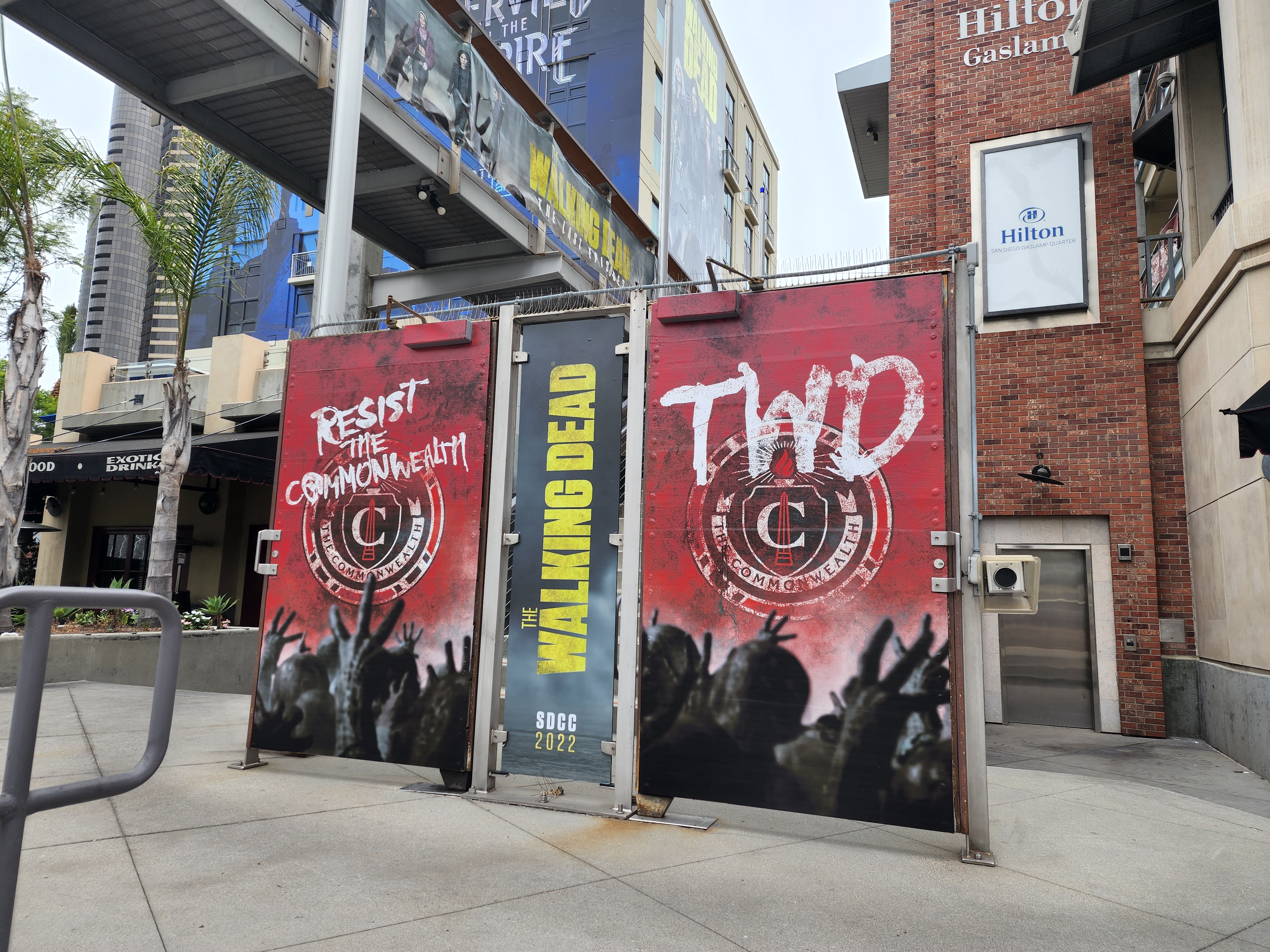
There were some old favorites too - such as what seems like the 18th year of Walking Dead offsites. (I know it isn't really.) In fact, seeing wraps for Anne Rice's Interview with the Vampire and Beavis and Butthead gave today a few nostalgic 90's feel. 


Some of the cosplay has been top-notch, despite it being pre-Con. What happened to cosplayers during pandemic lock-down? Did they dress up alone before their bedroom mirrors? Post a lot of selfies? That must have been frustrating. 

On the other hand, maybe some have used this time to plan extremely sophisticated cosplay and we'll all be blown away this week. This guy told me his name. Rory? Russ? He looked great. No doubt we'll see more cosplay from The Mandalorian, Moon Knight, WandaVision, etc.


As I'm sure you know, we only got 2 bag choices this year. Well, "choice" is not the right term. My friend really wanted the one with Black Adam on the back and of course, they didn't have any where we were. Same as it ever was. And, not to whine about this again, but I really miss the physical copy of the Souvenir Book.

Still, there was no wait to walk in, go up to the Sails Pavilion and grab our stuff. On the whole, today has been really manageable. Even the Exhibit Hall line was not that long around 3:30 when I was buzzing around up there.


What do you think so far? What have you seen? I'll report back after Preview Night. 

Thursday, November 25, 2021

It's time for Comic Con: Apocalypse Edition

 25 NOVEMBER 2021


It's here! Comic-Con Special Edition - the first SDCC of any kind we've had in 2.3 years - launches in less than a day. It's true that some people view this Con as a boondoggle, lacking the celebrities and parties that make SDCC so riveting, but others are looking forward to a more laidback weekend. Some of us like the idea of a chill Comic-Con - something that's previously been an oxymoron.


So far the scene is looking rather ghosttownesque - but that's true of most places on Thanksgiving morning.


I did see this fun La Brea activation. I feel like I'm the only person who watches this show, but maybe it's more popular than I thought. Hopefully this will include the giant prehistoric sloth who stars in it.


My favorite sign so far. I love the idea of COVID being an event that ends on a specific day, like a gruesome street festival.


Now. If you're stressing over bringing and possibly losing your vaccine card, allegedly you can show photos of it and you're good. Allegedly. After you show it, you receive an attractive wrist brand that marks you as one of the Approved. So don't worry that you'll have to flash your card around constantly.

Onto the real question: will this Comic-Con be fun? I think that the fun quotient will be in your hands. Manage your expectations; focus on bonding with your friends and exploring new fandoms or interests. SDCC is so crowded that a lot of us operate within narrow parameters. To access our favored panels or events, we spend a lot of time in line. That shouldn't be as much of a factor this weekend, so ideally we'll all have more time to broaden our nerdly horizons.

And there's the museum opening.

We'll see. If you're here, enjoy the rare event of a Comic-Con that's more spacious, more leisurely. And if you're not - July 2022 really isn't that far away.


Tuesday, April 23, 2013

Oh, you and your sophisticated CRM system


I had no idea businesses still sent out these kind of emails in 2013 but apparently they do. The whole point of personalization/CRM tools is to foster loyalty on my end and at least a whiff of authenticity on their end. But having obvious customer name/patient name fields destroys that illusion just a bit.

Way to make me and DIEGO feel cared about, University Vet. I had no idea my cat had such a large personality that his name was spelled in capital letters, but apparently you grasped his essence.

(I actually love this place and they have provided excellent care to all of my animals for the last ten years. They just need to tweak their system a bit.)

Thursday, April 11, 2013

Do we all need more space?


Here's an interesting statistic on office space: in the 1970's, every office worker had about 500 square feet to call his/her own. Today most workers have about 176 square feet - and  that's predicted to shrink to 100 by 2017.

That's kind of incredible. Amidst all the complaints about stagnant wages and disappearing pensions, we've forgotten to notice that our actual physical real estate is evaporating too. And the effects of this are particularly deleterious to we creatives, or so claims this fascinating article called Introverts,Extroverts and the Future of Work.

Anyone who's spent time in a variety of offices (like, say, freelancers) has noticed the range of seating design. High cubicles, low cubicles, suites, and odd geometric configurations all do a mixed job of offering accessibility while preserving privacy. But surely nothing offers less privacy than open-plan offices -arrangements that force everyone into a kind of exposed togetherness without a barrier in sight.

Open-plan offices usually look stylistically clean and hip, and I suspect it's for this reason that people assume they will foster stylish and hip ideas. But they don't, as studies are beginning to show. Instead they often foster stress, distraction and insecurity. There's a lack of productivity, as the collaboration they're designed to engender comes at the cost of focused work. This is especially disastrous for creatives, programmers and other workers who need a measure of isolation and privacy to make their magic happen.

70% of offices are now open-plan. While more companies show a commitment to designing space in tandem with different kinds of work, the reality that creative work demands its own kind of environment  isn't always a popular one. Too many corporate minds think they can plunk a writer or designer down in front of a laptop, surrounded by conversations and ring tones, and expect a fast and dazzling piece of work. Hopefully the recent research into office spaces will drive home the reality that we all need a little privacy sometimes - that we're humans, not machines.

What kind of marketer are you?


Okay, this insightful article by Frances Yu of Deloitte focuses on CMOs, but let's say it applies to some of us peasants as well. Namely she focuses on why so many CMOs still feel hard-pressed to provide hard data proving ROI. Which I think is a struggle almost every business owner and marketer has tasted at some point.

Is this working? Why aren't the numbers more impressive? This was supposed to rake in the sales. Everyone has felt disappointed by their CTR or some other metric at some point.  But Yu says CMO personality types may be somewhat culpable for a lack of good "proof."  These types are the fighter pilot, the innovator, and the data perfectionist.

You can read the article to find out if you qualify as one (or all three) and learn her solutions for triumphing over self-sabotage. These are very real patterns and stumbling blocks she's identified, such as an addiction to data poisoning innovation: "there is a real risk of past data choking future stars."

Oh, Frances, what pretty things you say. But she's right: getting too obsessive about numbers can cut innovation off at the knees. And if you take her theories a step further and imagine these different personalities working together on the same team, you can imagine the resulting friction and stalemates. It's food for thought, at the very least.

On hiring those expensive freelance writers


Well! My last post got some feedback - not all of it positive. Apparently I came off as "cocky." I expect my assertion that writers deserve to be paid real money and not scraps was to blame, or my failure to show "gratitude" for being paid at all, as someone suggested. Which springs from the exact attitude I decried, that writing and other commercial arts don't count as real labor.

But rather than dwell on the negativity, or take snarky shots, I'm going to put on my client hat - which I do wear from time to time. I hire people too, after all, not just designers or contractors, but other writers for various projects. And like many clients, I've been burned. Writers who failed to make deadlines, failed to show up at all, failed to deliver work that looked anything like the specs requested - it's happened enough that I understand where the Flaky Creative stereotype comes from. So I get why some people only want to pay some creatives a pittance.

To make a few points on getting your money's worth from your writer:

  • Look at your marketing as an investment, not an expense. You're not throwing away money when you hire someone to write a press release or case study or web site - you're investing a small amount of money that will be paid back many times over in sales.

  • Realize that saving two hundred dollars by hiring a mediocre writer over a good writer is a short-sighted business decision. Just as good content makes money for you, bad content loses money.

  • On that note, don't get hung up on the hourly wage. This is the element that sticks in the craw of most clients - namely because it's sometimes higher than their hourly wage. Leaving aside the obvious compensation package comparisons, consider that a good writer will often work more quickly than the cheaper writer and need less hand-holding and review cycles. The higher hourly wage writer may end up costing less.

  • If your cash flow is tight, be strategic. Figure out the priority collateral and don't be shy about repurposing content. (But do be aware of the difference in web writing and print writing if you do that.) If you tell your writer  you can't afford as many projects as you need, the writer might work out a volume discount with you or figure out ways to maximize the impact of the collateral you do produce. A few smart pieces are better than multiple clunkers.

  • If you have a decent wordsmith in the office, have them take a stab at the work and then hire an editor. Mind you, this works only when the writing is decent. It's faster to edit good work than it is to write it; but it is faster to write from scratch than it is to edit badly written work.

  • If you have a major project that is so critical you're nervous about entrusting it to a freelancer's hands, test-drive them first. Have them do a small project or two, and see if they're prompt and pleasant to work with and can hit the target without multiple phone calls and corrections. It's normal (and smart) to be wary of spending six thousand dollars on an unknown.

  • Understand that your writer doesn't just sit down at a laptop and start typing. There is competitive research to do, background reading, studying your style guide, lexicon and branding. There is concepting time. There are revisions. It's not as simple as "You can write 700 words in an hour, right?" which is the kind of thing a surprising number of people say when discussing project fees.

  • Lastly, if you come upon a writer who claims she can deliver a compelling, high-performing project for a tenth of what other writers would charge - ask yourself why she's leaving money on the table. Plenty of creatives have great recommendations on LinkedIn (from friends) and slick pieces in their portfolio (edited, polished or even created by someone else.) But if they're charging bargain-basement rates, it's a pretty accurate sign that they aren't good enough to compete with the real talent.


And there you have it - my cocky advice on hiring freelance writers.

Freelance writer rates - real statistics


Here's a contentious topic: the rates of freelance copywriters. This shouldn't be a touchy subject (no more so than any financial topic, anyway) and yet somehow it is the source of so much confusion and animosity. Some writers fret over what they should charge, some clients try to low-ball them, and misconceptions over what's "average" or "fair" spread like an oil spill. It can make the client-creative relationship very tense.

So anyone who's hired writers or worked as such might be interested in the 2012Freelance Industry Report. Carol Tice shares a few figures for copywriters: 78% earn over $50/hour, 53% make over $70/hour, and 24% make over $100/hour. Those are valuable stats for the many, many would-be clients who thinks writers "should" earn $15-20/hour. Or some other cockamamie figure they've pulled out of thin air.

Earlier this month someone called me and delivered a standard flattery-insult approach. She loved my writing, she gushed, I was so talented, had such a perfect voice for her blog, and was a league above her current freelancer. And after listing the current freelancer's many faults... she offered me the exact same bargain-basement rate. I gave her my actual (reasonable) rate and she was aghast, then irritated. Why wouldn't I write blog posts for fifteen dollars? Why didn't a good writer cost the same as a bad one?

I've heard all of the arguments for trying to pay writers badly: that's more than I make an hour; I could write it myself; I'll wait and see the ROI first; I could hire someone in Thailand for $5 an hour; writers are a dime a dozen; are you out of your mind; and so on. People who think nothing of spending two hundred dollars to get their hair highlighted, who don't blink at paying a plumber three hundred dollars for a service that took under an hour, will screech with horror at the idea of spending more than fifty dollars to have a web site written. Even though they're talking about the face of their business - their livelihood, their career.

There's a mental disconnect that often comes into play between service and income when the service is creative. But professional writing in particular seems to incur a certain contempt; an ill-informed but unquestioned conviction that good writing is so easily had and so infrequently needed that a writer should be grateful to receive even pennies as compensation.

Experienced clients know the opposite is true - it's not easy to find a skilled writer, let alone one who can quickly comprehend your business initiatives and partner them with compelling copy that smoothly incorporates SEO, branding and strategy. Which is why the above rates are as high as they are. Good copywriters aren't desperate or starving because we provide a high-value service that makes money for our clients - and our rates are worthy every penny and more.